Facebook
 X
 Pinterest
 Copy Link
A striking home can capture your attention immediately. But what makes it memorable—the roofline, the materials, the light, or the way the rooms connect to the outdoors?
In Orange County luxury real estate, architecture shapes both first impressions and everyday living. Understanding a home’s style helps buyers compare properties more thoughtfully and gives sellers a clearer way to communicate what makes their home distinctive.
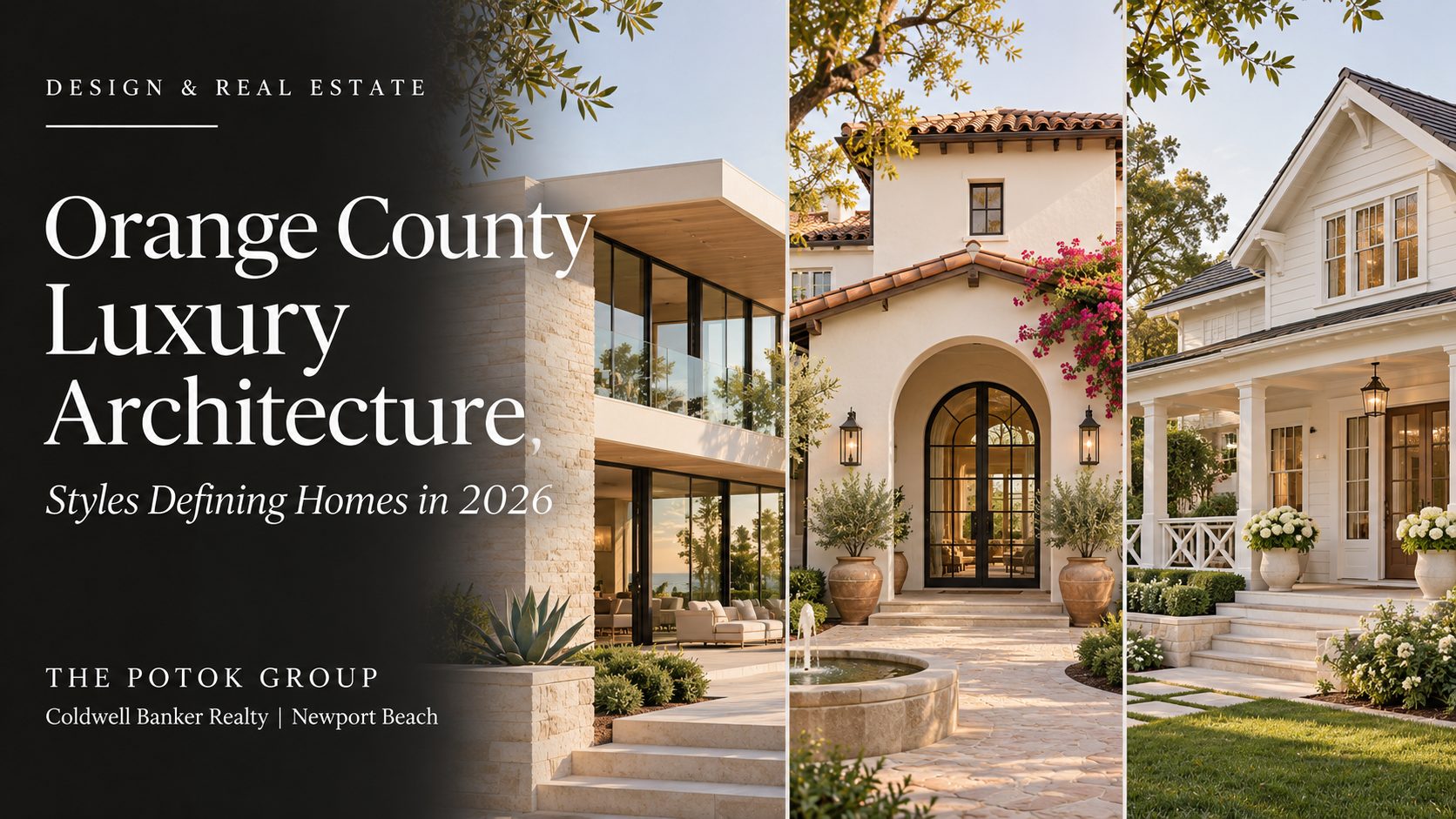
For a 2026 Orange County luxury home search, coastal contemporary, Mediterranean-inspired, modern organic, coastal traditional, and transitional designs provide a useful framework. These categories often overlap, and this guide is a design overview rather than a ranking of sales or buyer demand.
Whether you’re exploring Newport Beach homes or preparing to sell in Laguna Niguel, here’s how to recognize these styles—and evaluate what they offer.
1. Coastal Contemporary: Light, Views, and Clean Lines
Coastal contemporary architecture emphasizes simple forms, generous glazing, and a strong relationship between interior and exterior spaces.
Look for broad window openings, restrained detailing, open gathering areas, and terraces that extend the living space. Materials might include smooth stucco, stone, wood, and metal.
For a Newport Beach or Corona del Mar search, this style provides a useful lens for evaluating how a home frames its surroundings.
The important question is how the design performs. Does afternoon sunlight create glare? Is there enough privacy? Can you comfortably furnish the main living area?
Buyer takeaway: Evaluate orientation, shading, window condition, and outdoor usability alongside the view.
Seller takeaway: Photography should explain the architecture—showing sightlines, connected spaces, and natural light without obscuring the home’s actual setting.
2. Mediterranean-Inspired: Character With Room for Reinvention
Mediterranean-inspired homes can feature stucco walls, tile roofs, arches, courtyards, and substantial entryways. Spanish and Italian influences vary, so the label describes a broad family of designs rather than one precise formula.
Local architect Brion Jeannette’s portfolio includes both a Mediterranean waterfront home with contemporary influences and a contemporary reinterpretation of Mediterranean architecture. These examples illustrate how established forms can accommodate a fresher design approach.
For buyers comparing Newport Coast luxury homes or other Orange County estates, distinguish the underlying architecture from decorative finishes.
Heavy fixtures, paint colors, or dated cabinetry may be changeable. Rooflines, ceiling heights, circulation, and window placement require a different level of evaluation.
Buyer takeaway: Consider whether you appreciate the home’s fundamental proportions before planning cosmetic changes.
Seller takeaway: A cohesive presentation can highlight arches, courtyard connections, and craftsmanship while allowing buyers to understand the floor plan.
3. Modern Organic: Warmth Within a Contemporary Framework
Modern organic is primarily a design approach rather than a historic architectural style. It pairs contemporary forms with natural textures and warmer finishes.
Think wood cabinetry, stone surfaces, plaster-like finishes, softened edges, and a restrained palette drawn from nature.
Houzz’s 2026 design coverage identifies textured materials and warm wood among the year’s design themes. Its fall coverage also describes warmth as an established foundation for interiors. These are national observations, not measurements of Orange County buyer preferences.
For an Orange County luxury buyer, the appeal is easy to understand: a clean-lined home can still feel comfortable and inviting.
However, appearance alone does not establish quality. Ask about the actual materials, installation, maintenance requirements, and durability.
Buyer takeaway: Look closely at craftsmanship and finishes rather than relying on a listing’s style description.
Seller takeaway: Texture and thoughtful lighting can communicate warmth, but updates should complement the architecture and fit your preparation budget.
4. Coastal Traditional: Familiar Forms and Detailed Craftsmanship
Coastal traditional homes draw on established residential forms, often incorporating pitched roofs, defined windows, millwork, porches, and paneled details.
The result can feel layered and welcoming, with architecture that gives individual rooms a clear identity.
When comparing Newport Beach or Balboa Island properties, this category can help describe homes whose character comes from proportion and detailing rather than expansive glass walls or minimalist surfaces.
Avoid assuming that “traditional” means closed-off or impractical. Some homes combine recognizable exterior forms with updated interiors and flexible living areas.
The quality of the adaptation matters.
Buyer takeaway: Check room dimensions, storage, circulation, and whether renovations work with the original structure.
Seller takeaway: Highlight distinctive details and useful spaces. Accurate descriptions of cabinetry, built-ins, and outdoor areas are more informative than repeatedly calling the home “timeless.”
5. Transitional: A Bridge Between Traditional and Contemporary
Transitional design blends elements of traditional and contemporary homes. You might see a familiar exterior paired with simplified interiors, updated lighting, and an open kitchen.
Because the term is broad, two listings described as transitional may look entirely different.
For buyers searching Irvine, North Tustin, or Ladera Ranch luxury homes, the label should begin the conversation rather than settle it.
Ask what was changed, when the work occurred, and whether the improvements create a coherent whole. An updated kitchen does not necessarily mean the roof, plumbing, or other systems were updated.
Buyer takeaway: Separate design improvements from the property’s overall condition.
Seller takeaway: Describe the actual renovation scope and available documentation. Specific information helps buyers assess the offering.
What Matters More Than the Style Label?
The strongest home for your needs brings together design, condition, location, and function.
During a showing, consider:
- Light and privacy: How do windows relate to neighboring properties?
- Daily use: Can the layout accommodate your work, storage, and entertaining needs?
- Outdoor connections: Are patios and terraces genuinely usable?
- Maintenance: What care do the exterior materials and features require?
- Renovation feasibility: Have appropriate professionals evaluated your proposed changes?
For sellers, architecture provides a valuable marketing story. It does not establish a guaranteed premium. Pricing still requires relevant comparable sales, current competition, and careful consideration of the property’s condition.
Frequently Asked Questions
Which architectural style is best for an Orange County luxury home?
There is no universal winner. Choose based on how the property supports your priorities, including layout, privacy, maintenance, and outdoor living. Style is one part of the decision.
Is modern organic the same as contemporary architecture?
No. Contemporary architecture concerns the building’s design, while modern organic often describes its materials and interior treatment. The two can work together, but they are not interchangeable.
Can a Mediterranean-style home feel current in 2026?
Yes. Thoughtful lighting, finishes, and furnishings can refresh its presentation. More substantial changes should be evaluated with qualified design and construction professionals.
Should I renovate my home to match a popular style before selling?
Evaluate the likely cost, timeline, and relevance to competing properties first. Focused preparation may make more sense than a major stylistic transformation. No design update guarantees a higher sale price.
Find the Architecture That Fits Your Next Move
Your home should offer more than an appealing style description. It should work for the way you live—and be presented clearly when it is time to sell.
Schedule a consultation with Hailey Potok and The Potok Group at Coldwell Banker Realty, Newport Beach. We’ll discuss your design preferences, evaluate relevant Orange County properties, or develop a selling strategy that highlights your home’s distinctive architecture.

Hailey Potok
President, The Potok Group
C: 714-878-0877
CA DRE #02024094
840 Newport Center Dr., Ste. 100
Newport Beach, CA 92660